
The question I sat with in France was simple: go deeper into research, or take what I had learned into the world? I chose the world. It took forty years to understand that the answer was both.
The photograph was taken at the old Promenade des Anglais, in Nice, in the early 1980s, when the moment to decide my path was very close. I used to sit there to think — to sit with the question long enough to be sure. Science had given me a way of seeing. The question was what to look at with it.
I chose the private sector. What I did not choose was to leave the science behind.
Career Arc
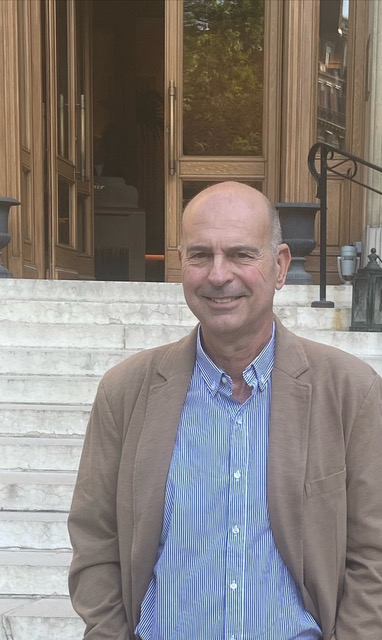
Allergan: Where the Standard Was Set
I joined Allergan as a Scientific Advisor in 1986, a role that lasted three months before the company offered me an executive position. At the time, Allergan was primarily an ophthalmic company, and my entry point was the contact lens care products division. The scientific formation was immediately useful: I was explaining mechanisms to physicians, not reading from a marketing script.
The company's trajectory changed dramatically in the late 1980s when Allergan acquired BOTOX, then known as Oculinum, from Dr. Alan Scott. What followed was one of the most challenging and formative experiences of my career. BOTOX required launching into an entirely different clinical world: different physician specialties, different disease frameworks, different evidentiary language. The paradigm shift from ophthalmology to neurology and aesthetic medicine was profound, and my scientific background proved to be a decisive executive advantage. Understanding the mechanism well enough to explain it credibly to regulators, skeptical physicians, and markets that had no framework for what they were being offered — this is not a skill most executives bring to a product launch. I had it.
From Scientific Advisor, I moved through VP of Sales and Marketing for Argentina and Brazil, then to Interim CEO for Mexico at twenty-eight, and finally to CEO of the Southern Cone (Argentina, Uruguay, and Chile), a role I held for ten years. Twelve years in total inside a pharmaceutical company where claims required evidence, mechanisms required understanding, and the gap between what a product does and what its marketing says was not tolerated. That standard stayed with me.
Latin America Expansion: The Harder Achievement
From Allergan, I moved into the direct-sales cosmetics sector — first as President of Mary Kay for the Southern Cone, then over twelve years at Natura Cosméticos in progressively larger roles. The work I am most proud of at Natura is not the Brazil years, though those were significant. It is the Latin America expansion.
As President of Latin America excluding Brazil, I led a lean, highly efficient team that opened and relaunched seven new markets across the region, taking combined sales from less than one million dollars to over one hundred million dollars per year. Building something from almost nothing, in markets that did not yet know the brand, with a small team and no institutional momentum, is a different challenge from managing an established organization. It is the challenge I find most interesting.
The Brazil years were significant nonetheless. As CEO of Natura Brazil, I led an organization of 4,500 employees and 600,000 independent sales consultants. We doubled sales in three years. We achieved the number one market share position in cosmetics, fragrances, and toiletries across Brazil, displacing Avon, the sector's historic leader, for the first time in the company's history. Argentina's Fortuna magazine, the regional equivalent of Fortune, ran a cover feature on the story. The Brazilian and international press covered it extensively, in Portuguese, Spanish, and English. See the Press section →
MonaVie: Making a Company Worth Buying
In 2013 I became President, CEO, and Chairman of MonaVie, a nutritional products company with global operations headquartered in Salt Lake City. The company was in decline. I was brought in to diagnose what had gone wrong, propose a turnaround plan, and execute it. We stabilized sales, reduced expenses by more than 66% versus the prior year, achieved growth in North America after four years of decline, and opened the Chinese market.
My job was to make the company commercially viable again, to turn it into something a buyer would want. That work succeeded. The institutional investor then ran the sale process, which was not my role and not my story to tell. My role was to fix what was broken. I did.
Hairstory: The Right Problem at the Right Time
I became a co-founder of Hairstory at fifty-four, not because of restlessness, but because of alignment. The science was genuinely novel. The problem — that conventional shampoo strips the hair of its protective sebum film, creating the dependency cycle that the rest of the product chain exists to manage — was real, mechanistically clear, and solvable. The partners shared a specific conviction: that earning the consumer's trust through results was worth more, and more durable, than spending to tell them what they wanted to hear.
We launched the brand in four months. We reached ten million dollars in sales in 2019, profitably. From the startup valuation at the time of the initial fundraising to the valuation at private equity entry six years later, the company had grown ten times in value. The scientific case for what we built — the detergent-free cleaning system, the threshold argument, and the color-retention evidence — is documented in the six-article Hair Science Series published on this site.
Research and Publications
My academic research was in microencapsulation — the technology of encapsulating active compounds within lipid membranes to control their delivery and protect them from enzymatic degradation. This work resulted in several peer-reviewed publications in international journals. Among those: one published in Antimicrobial Agents and Chemotherapy (American Society for Microbiology, 1985), and one in the Journal of Microencapsulation (Taylor & Francis, 1988), which has been cited by 46 subsequent papers across pharmaceutical, antimicrobial, and cosmetic science.
The research background is not incidental to what followed. Microencapsulation is directly relevant to surfactant science, emulsion mechanics, and lipid-based delivery systems — the chemistry underlying the formulation work at Hairstory. Understanding why charged liposome membranes bind preferentially to the hair surface is not a departure from understanding how liposomes protect antibiotics from enzymatic hydrolysis. It is the same science applied to a different surface. The formation was continuous, even when the context changed entirely.
What I Do Now
I consult for companies in the pharmaceutical and cosmetics industries — typically organizations facing strategic inflection points, turnaround situations, or the challenge of bringing science-based innovation to markets that are not yet ready for it. I bring four decades of executive experience across multiple sectors, multiple markets, and multiple cultures, and I bring a scientific standard for evaluating claims that does not change based on the commercial convenience of the answer.
I give lectures and training sessions on cosmetics science, leadership, and the intersection of scientific rigor and commercial communication. I have spoken publicly in more than fifteen countries, in five languages, more than five hundred times.
And I write. The Hair Science Series on this site is one part of a larger project: applying the same scientific honesty to the vocabulary of industries that have learned to substitute compelling language for accurate description. Hair care is the first subject. Leadership is the second — what it actually requires, what it actually produces, and why so much of what gets called leadership is something else entirely. The standard is the same in both cases: describe what actually happens, through what mechanism, and for how long — plainly enough that the reader can evaluate the claim independently.
The consumer who understands the mechanism is better served than the consumer who believes the claim. The same is true of the employee who understands what leadership actually requires.
The International Dimension
I hold triple citizenship — American, Argentine, and Italian. My mother was French. My father was Italian. I have circled the globe seven or eight times, visited more than forty countries, and lived and worked across South America, Europe, and the United States. I speak Spanish, English, Portuguese, and French fluently, and Italian proficiently.
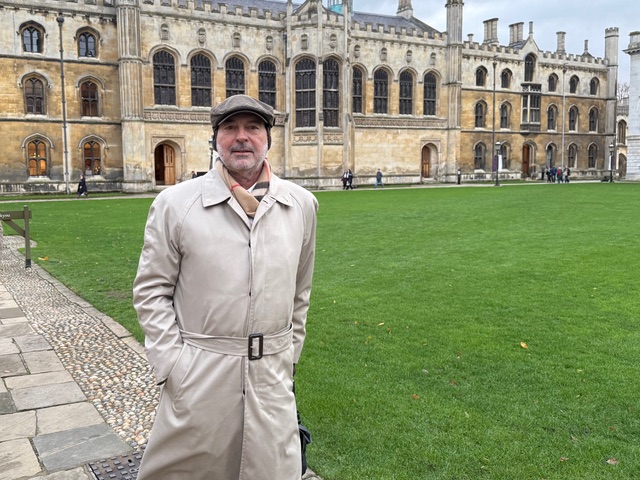
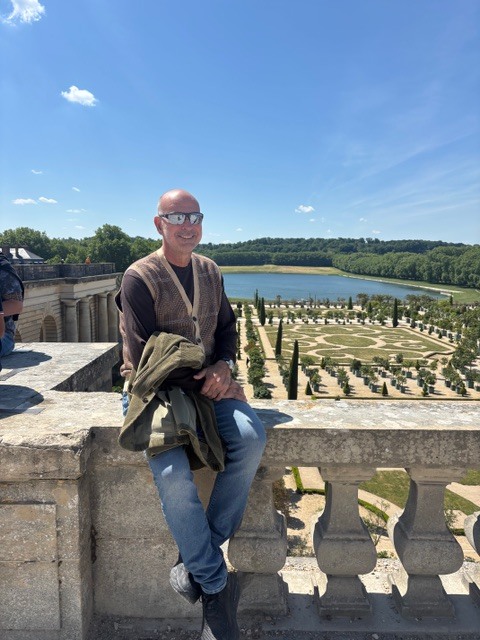
None of this is a travel résumé. It is a formation. The curiosity that makes me want to understand the history and culture of every place I go is the same curiosity that makes me want to understand the mechanism behind a claim rather than accept it at face value. In New York, I was a member of the Metropolitan Museum and MoMA. I went to Cambridge to stand before Newton's work — and to attend the graduation of a dear family member, because both mattered, and I do not separate them. I go to Versailles every year because, in some sense, it is part of my roots. When I traveled for work, which was constant, I always found time to be somewhere rather than just pass through it.
Being international is not something I do. It is something I am. The scientific part of my brain has the same appetite for cultural and historical understanding that it has for mechanism and evidence. I believe there is no more genuine form of respect for other people than the willingness to understand how they see the world. That belief has shaped every executive role I have held, across cultures, languages, and markets that did not share a common framework, and it shapes how I write.
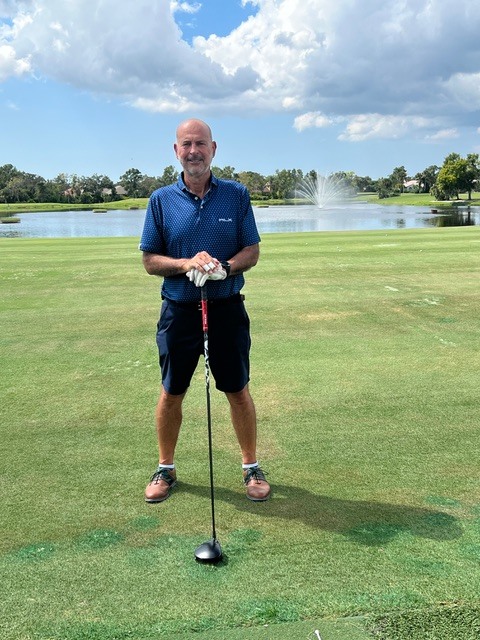
I live in Florida. I am in my 60s. I have no intention of slowing down.
Contact
Consulting inquiries, speaking engagements, and press are handled through DaumDeuman, my consulting practice. The name combines two words from the Mapuche language, daum and deuman, meaning "strategy" and "implementation," respectively. The combination is intentional: I do not believe in advice that cannot be executed, or in strategies that exist only on paper. Practicality is not a limitation. It is the point.
Email: mauriciobellora@daumdeuman.com
Substack: substack.com/@mgattobellora